
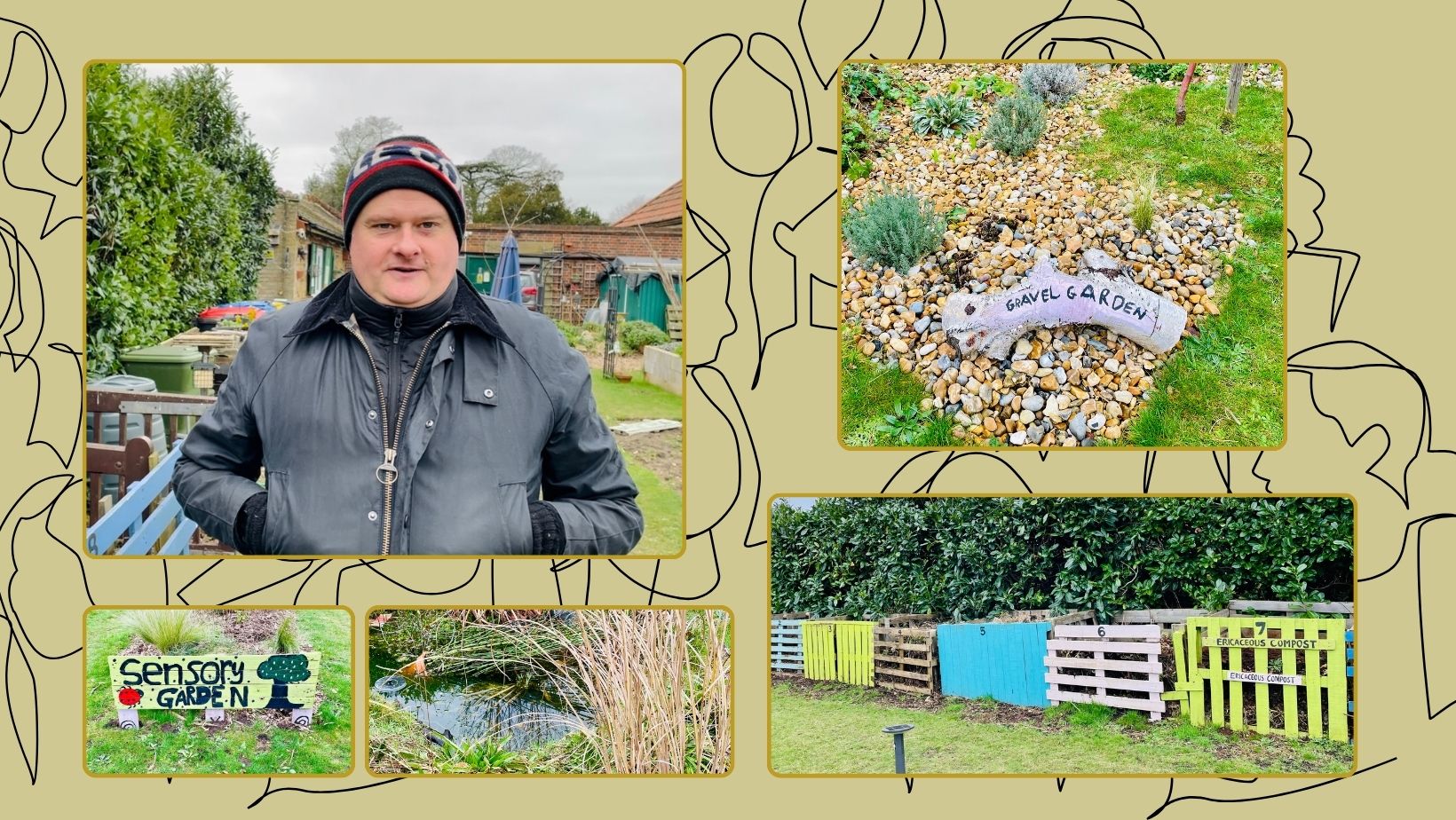


I recently visited not-for-profit, volunteer led Elmbridge Community Eco Hub, located near to where I live in Walton-on-Thames, to interview Founder and Director Mick Tumilty. The Hub opened its doors two years ago in February 2022 to provide a number of initiatives that bring together the community in a safe environment, encouraging skill sharing, recycling, waste reduction, tool and equipment lending, refill shop, food production and more. The Hub also has a Community Fridge that allows local people to collect free food donated by local supermarkets, which would have otherwise been wasted. Mick’s an extremely determined person who’s faced many personal challenges but he’s turned those difficulties into positives for himself, his family and thousands of people in the local area. Read on to find out how he set up the Hub and check out your local Hub. If you don’t have one and you feel inspired perhaps consider starting something similar.
Watch this video and find out about the no-dig/dig bed combinations in the Hub’s Community Garden and how Mick sources their mulch.
What’s your background Mick, and why and how did the idea for the Hub come about?
I spent 26 years working in academia and medical research. I was a big guy and when my son was four he saw the programme The Biggest Loser and he said daddy you could be on that. That set off a really intense exercise regime, I lost a lot of weight and got really fit to the point I was called into the Irish squad for triathlon at age group level for two European Championships and a World Championship. I then got hit by a car cycling to work at St George’s Hospital in London, which was the catalyst for a really bad 18 months. That trauma affected my confidence; we had lots of deaths in the family, I then had a spontaneous bowel rupture and the combination of all those events sent me into a spiral of depression. I took a year off work and I lost all sense of purpose.
I was walking the kids to school and when you’re walking with eight-year-olds you’re loitering and I started noticing the litter. I thought I’m not going to complain because the council doesn’t have the time or the resources so I bought myself a litter picker and the next day I started litter picking with the kids. The day after I had to buy three more because my kids wanted to help, then I had to buy one for my wife. That was November 2018. My wife then coined the phrase Commit to Your Street and we started trying to encourage people on social media to keep their street clean. Commit to Your Street now has 400 members, I was litter picking every day and I became an ambassador for Keep Britain Tidy. During this time, I started to realise that there was more we could do.
I then saw an initiative called The Library of Things on Countryfile. I loved the idea and thought I can do that so I put a post on Facebook and then someone said, have you heard of a Community Fridge and I looked that up and thought yep I’m going to do that too, then someone said, have you heard of a Repair Café so I looked that up and thought yep I’m going to do that as well. We did a lot of research, we went and met people who had already started Hubs, we travelled to different Community Hubs and we felt really inspired.
Then I set about securing a building. I walked the streets in Walton and asked in shops if they could provide funding and unsurprisingly they all said no. I walked into the estate agents and asked if they had any free buildings and they said no. I walked into PA Housing and they loved the idea and offered us £5000 to get started. They said the reason we’ll give you the money is because this will impact our customers but the caveat is you need to get a venue and a bank account. We found a site and were negotiating maintenance contracts when the roof fell in making it uninsurable. The council then offered us the old Bowling Club building, which was in a real mess. We took it on and spent four months making it safe. At this point I’d appointed a committee; I’d got together with likeminded people including a local woman called Anita Aston who’d already run a recycling project from her home. We used some of the PA money to buy wheelie bins. We had people on the committee who were part of organisations like XR and Friends of the Earth but I emphasised straight away that we’re not lobbyists or campaigners, for the project to work we needed to have a gentle approach.
Then Covid hit. During this time many people were losing loved ones, income, community and a sense of purpose. I decided that without changing any of the initiatives we needed to spin the purpose of the Hub so that it was about people. That’s when the narrative became the Elmbridge Community Eco Hub rather than the Elmbridge Eco Community Hub. I polled local people on Facebook and said what’s the most important word to you in this sentence and they all said community. We then secured a lease on the building for two years. It was ramshackle and before we were even open we were broken into and the bits that we’d brought in were stolen. It didn’t put us off in fact the local media wrote about it and we got a lot of donations. We were then able to put security cameras up and fit an alarm. Then I applied to the council for CIL Funding (Community Infrastructure Levy) and we had double glazing fitted, we put a defibrillator outside and installed solar panels so we could generate a little bit of our own electricity. The community came together and upgraded the electrics for us, we had a joiner fit skirting boards, someone else installed hot water. The first CIL payment paid for the solar panels and battery inverters and the second paid for a porch.
PA Housing approached us again and said they couldn’t give us more money but their contractors had some CSR days (Community Social Responsibility Days) and they asked what we needed. We told them it was a bit cold in the building and that we could do with some insulation. In December 2022, they installed plaster board insulation on the whole roof and the ceiling and decorated it.

The Hub has an impressive nine compost bins and a hungry bin for the worms. Watch this video to find out more.
The Community Fridge is understandably the most popular initiative. How does it work?
Community Fridge is organised nationally by Hubbub, you sign up to it and then you have to prove that you’re clean, safe and hygienic. They then give you money to buy and maintain a fridge, train your staff in basic food hygiene, cover volunteer costs, cleaning material and contribution to your insurance. It’s great having the infrastructure but you need to have a food supply chain and for this we contacted two organisations, FareShare and Neighbourly who assess you for fitness to supply food. When they’re satisfied that you meet all the environmental health regulations they contact the organisations that they work with. Both organisations essentially do the same thing but FareShare work with Waitrose and Tesco and Neighbourly work with Sainsburys and Lidl. They then contact those local supermarkets on your behalf and find out the volume of food that you’re likely to be given. You get an allocation of surplus food available on a specific day and time and you have to commit to collecting it.
We have about 30 volunteers on a WhatsApp group and we put a shout out and one of the volunteers will go and collect it in their own car. We have 30 collections seven days a week. Generally, it’s one collection per day from any one store, our collections are from M&S, two Waitrose stores and two Sainsburys. The donations generally include bread, fruit and vegetables, but as you’ve seen today we’ve lots of frozen meals, which is the exception rather than the rule. I’m hoping we get more because we have a large capacity freezer and we need to be filling it, emptying it and getting that food into people’s bodies. We also get chicken from Nando’s, which is a high value product.
There’s a lot of food out there that’s still going to waste that doesn’t need to be. We get a ping in the morning and it tells us how much the supermarket predicts they’ve got so we know what size vehicle to send. Today we were told there would be a small amount but it was much more than predicted. We weigh everything when it comes in and goes out. Everything we do is based on data; it’s how we measure impact. We ask every individual that comes in for food to complete a form that shows the date, type of food they’re taking, weight and whether it’s for themselves or a community group and most importantly if it’s their first time. This is important because we need to know that the message about the Community Fridge is still getting out there. This allows us to see patterns, we know that cumulatively, from the time we opened in February 2022 to yesterday (12th January 2024) we’ve saved 36,365kg of food. I also know that food has gone to 9000 people locally – approximately 1000 different people. In the first month we saved 85kg of food now we’re saving about 400kg per day. Last month we had 1,300 people visit the Community Fridge and 260 of those people were new. This is being exemplified by the cost-of-living crisis. Community Fridges are non-judgemental and non-bias we don’t ask questions about people’s social status. The analogy I use is, if someone lands in a private helicopter in the field behind and someone else comes in with holes in their shoes they get treated exactly the same.
What’s a little bit sad is that we do 15 different initiatives but most people only come in for the Community Fridge, they often don’t see the other benefits. Out of 16,000 visitors 9,000 have come in for food, the rest come for recycling, engage with the book share and jigsaws, borrow something from The Library of Things. We also get a lot of youth groups coming in between March and September. We spend a couple of hours with them, we provide a tour around the garden, talk about growing food and sow some seeds. We write their names on the label so they can come back and show their family the plant they sowed. We also work with the food bank, they tend to give out preserved food so they give us any leftover bread, fruit and veg and we give them preserves, sanitary products and other long shelf-life items.

Mick says it’s important that the Hub is fully circular and that any waste goes back into the system through composting or providing feed for chickens and pigs at a local farm. Watch this video to find out more.
Can you talk about some of the other initiatives that you offer?
We’ve got 305 members for the Library of Things. There’s a £10 a year joining fee, which provides a contribution towards insurance. In just under two years, we’ve loaned out items 1000 times, it’s really popular and it’s our only income stream. There’s also a small rental fee depending on the item and how long it’s borrowed. Responsibility for insurance, maintenance and storage fall on us and that’s the beauty of the project, why go out and buy an expensive rotavator when you can borrow it from us for £15? The best analogy is a drill. A drill can drill a thousand holes but you don’t need a thousand drills to drill a thousand holes. It’s not high-end equipment because it might be stolen, it’s safe, cordless, high DIY level. We get a lot of these items donated but everything has to be tested to make sure it’s safe, working and complete and we check the items again every time they come back from hire. We have about 90 different items ranging from chocolate fountains to our most popular, which is carpet cleaners. Our latest addition is a high-end projector and screen.
We like to empower people we’ll teach people how to use power tools for example. We have a Skill Share initiative, Sonya is our Skill Share coordinator and she identifies people who have a skill they can pass on, which could be a language, art, music, physical activity, anything. Our first Skill Share was a Ukulele session, we borrowed the instruments from a local school. We also have French sessions, cooking, sew and share, advice about finances and wills. For me it’s about getting people out of the house away from the TV. They can come here and have a coffee with friends, reducing isolation. It’s a real community asset. The sew and share group went from learning how to thread needles to creating outfits for a local pantomime, bunting for a local school made out of redundant old school gingham dresses, bags, they’ve even fixed two or three parachutes! They’re not used as parachutes anymore I hasten to add! They’re used by nature teams in the woods for shelter. Before she retired, the job of one of our older ladies was maintaining sewing machines and now she fixes the sewing machines that are donated. She gets really excited when she sees an older model! It’s very multi-generational within the sew and share group the oldest person is 80 and the youngest is 11.
What are the running costs for the Hub?
Last year running costs totalled £12,000 and this year they will total £15,000 because of bill increases. In December 2023, the electricity bill was £689.00 even though we were only open for three weeks. That’s one room, running two fridges a freezer and one heater just to stop the place freezing up!
You can follow Elmbridge Community Eco Hub on:
Facebook
YouTube
Instagram
Twitter
Leave a Reply