
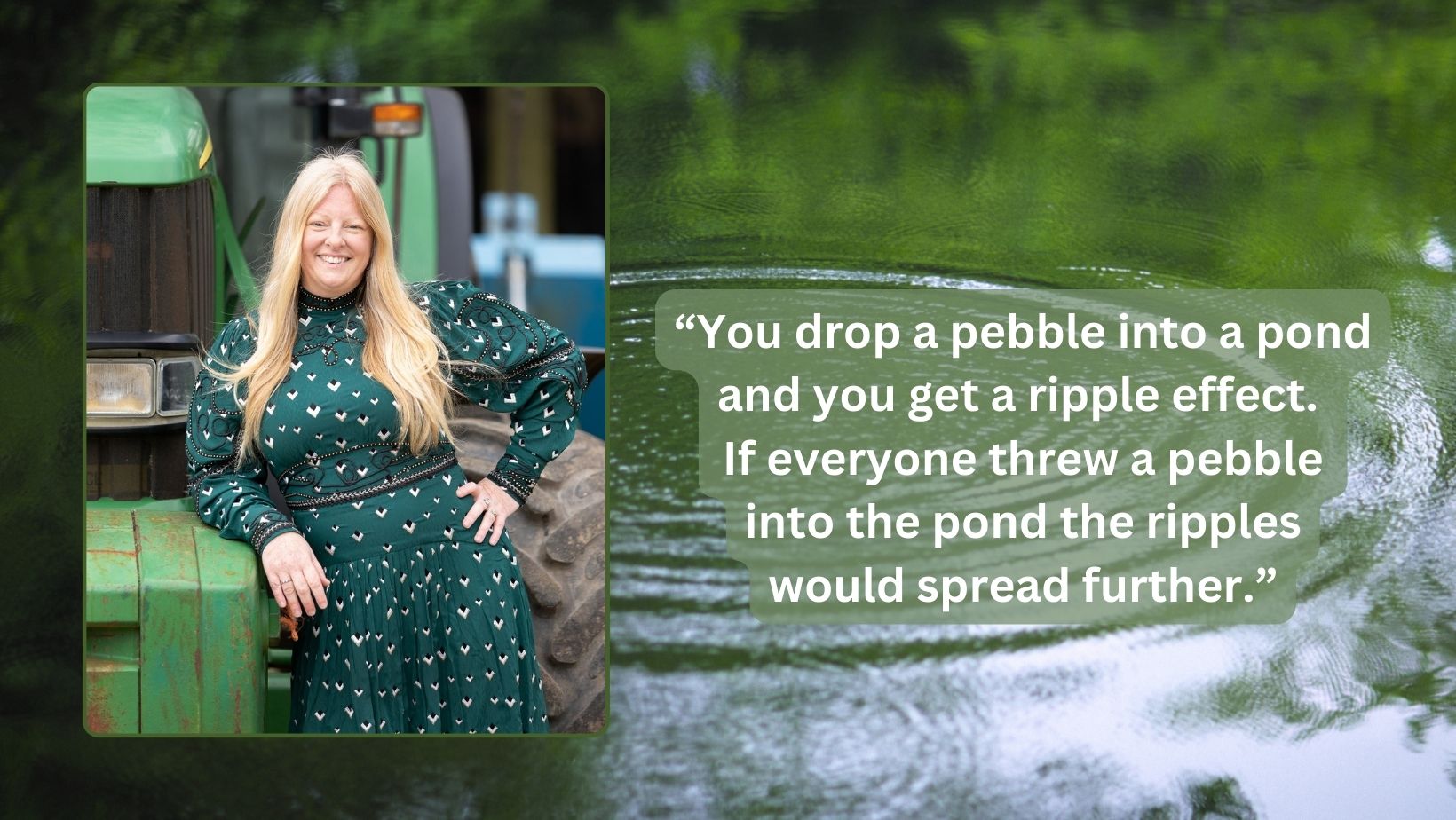


I first met Jenny on a Zoom call shortly after I joined the Six Inches of Soil team two years ago. She’s an award-winning author, columnist and radio producer/presenter, mum and regenerative farmer’s wife. As the author of four cookbooks celebrating farming, fishing and food around the world, and a fifth due to be released this week, I wanted to get her thoughts on the challenges that our farmers are facing and why education plays such an important role in fixing our broken food system.
The awakening
I’d always considered myself to be a foodie but until I met my husband John I didn’t know anything about farming. I’d never thought about the hard graft and passion that goes into producing food, from a simple loaf of bread to a glass of beer. Through John, my eyes were opened to so many different things, how food is produced, the provenance, the hard work, the countryside. He’s the source of my inspiration.
Through his dedication to protecting the environment, I began to realise that I couldn’t be the only person who was completely ignorant about where our food comes from, so I decided to write a cookbook. I’d just given birth to my eldest daughter, who’s now eight and I had a revolving kitchen door, I had to feed my new family and I didn’t know what to do or how to do it. One night, we had a dinner date and we started talking about all the different pockets of produce around the country, like cereal crops from East Anglia, rhubarb from Yorkshire, potatoes from Northern Ireland
I decided there and then to compile a cookbook with recipes showcasing the produce from different farmers located geographically around the country. In Britain we’re so disconnected from Mother Nature, from Mother Earth and I wanted to educate people about where their food comes from and to support farmers and fishermen who were starting to get some bad national press
In March 2020, at the start of COVID, there was a shocking front-page headline in the Mail on Sunday, where an adviser to the UK Conservative government (Tim Leunig) said, Britain doesn’t need farmers. My first book was published in July 2020 after the first lockdown and that headline really spurred me on to try and change the narrative and to give farmers a voice. COVID was actually a major turning point because people began to realise how important farmers are.

“No farmers no food” slogan and protests in Europe
Farmers all over the world are under immense pressure to not only produce highly nutritious food, but to diversify, engage with the general public and to educate the next generation. There’s so much pressure on food producers, especially farmers in this country. I think slogans like ‘no farmers, no food’ can be helpful because it’s accessible to the general public who may be fairly ignorant about the issues. But I completely understand that they don’t speak for all farmers and I think that’s the careful delicacy.
The protests are a symptom of how our political leaders have completely failed everybody on a catastrophic scale, especially our food producers. The food supply chain is totally fragmented, there has to be some kind of leadership and compassion and I think politics have completely failed on both counts. Not just in food, farming and fishing, but in all in all aspects of life. With the protests, I don’t understand what they’re hoping to achieve and when they do achieve it, what happens? In the UK we’ve got to be really careful about this and take the pressure off our farmers but it doesn’t help when certain politicians are promising too much and not delivering. Farmers are being used as scapegoats, we need a change of leadership quickly and then we can start building back.
Positive solutions for climate change
It’s so important to find the positives, my new book ‘Islands In A Common Sea’ celebrates all the positive, inspiring initiatives that are currently happening in food production worldwide. There are some amazing people doing incredible things and I’m definitely one to focus on positivity. It’s so easy to get bogged down in social media and the newspapers and to lose hope and lose the light. My books celebrate people and share stories about what they’re doing, why and how and to present this in a really accessible entertaining way.
Food security and food justice
There’s so much wrong with the system, education is the foundation of it all and we need good leadership. This country and the world thrive off charity, with volunteers working day in day out because they want to change the system. I wrote an article about it recently, there’s just so many people doing the same sort of thing in different pockets of different societies around the country. Everyone’s heart is in the right place in wanting to make a difference but there will be no fundamental change if the people at the top aren’t meeting the people at the bottom and in the middle. We desperately need a change of government and then, most importantly, a focus on education to reconnect the younger generation in the early years and to get food on the national curriculum.
Free school meals for all primary school children’s really vital, if children are hungry they’ll struggle to learn. Education about nutritional value is also important as well as cooking budgets for financial planning, food provenance, general knowledge about farming and fishing, the importance of buying local, regenerative farming and sustainability. There’s a fantastic charity called Fish in School Hero, who train teachers in secondary schools to prep and cook fish in the classrooms. Farm visits are also important, the Country Trust does fantastic work in this area.
*Country Trust is a national education charity dedicated to bringing alive the working countryside for children least able to access it. They also spearhead the Plant Your Pants campaign in the UK. I interviewed Chief Executive Jill Attenborough in November 2022 for a Six Inches of Soil blog, which you can read here.
All of this could be state funded, the fact that we have charities doing all this amazing work is a symptom of failure in politics and leadership. The root of linking everything together is education.

Rip up the school curriculum!
Democracy, education the national curriculum, everything needs to be revolutionised. There needs to be a massive food revolution and a democratic political revolution for things to change for the better. We’re at the lowest ebb across industries, with education, health, science, innovation, everything is broken.
Individual responsibility
There’s a fantastic quote from a Uruguayan journalist, writer and novelist called, Eduardo Galeano who said, “Many small people, in small places, doing small things, can change the world”. You drop a pebble into a pond and you get a ripple effect. If everyone threw a pebble into the pond the ripples would spread further. People are beginning to wake up but there’s a lot of pressure on us to make the change when realistically there’s only so much we can do. I think there has to be a sensible proportion, if we all stop using plastic straws and use paper straws it’s not going to change anything. There’s a lot of bandwagons that are being jumped on unnecessarily, to make absolute fundamental change we have to look at the food we eat and where it comes from, it’s at the root of everything.
Buy local
It’s the most important thing. Wherever you are in the world, you can support your immediate community by buying from local producers directly, supporting farmers markets, delicatessens, butchers, fishmongers and bakers etc. Doing this creates good reliable strong local economies and boosts community spirit. Buying seasonal is also really important. We’re so spoilt as consumers with an abundance of non-seasonal produce. The world is such a wonky place at the moment and it needs to be balanced out but people like you and I, consumers can start buying local and really support our food producers. Food is the seed of life, it’s the root of everything we do and why we do it.
You can find out more about Jenny on her website and follow her across socials:
Instagram
Twitter
Facebook
LinkedIn
Leave a Reply