
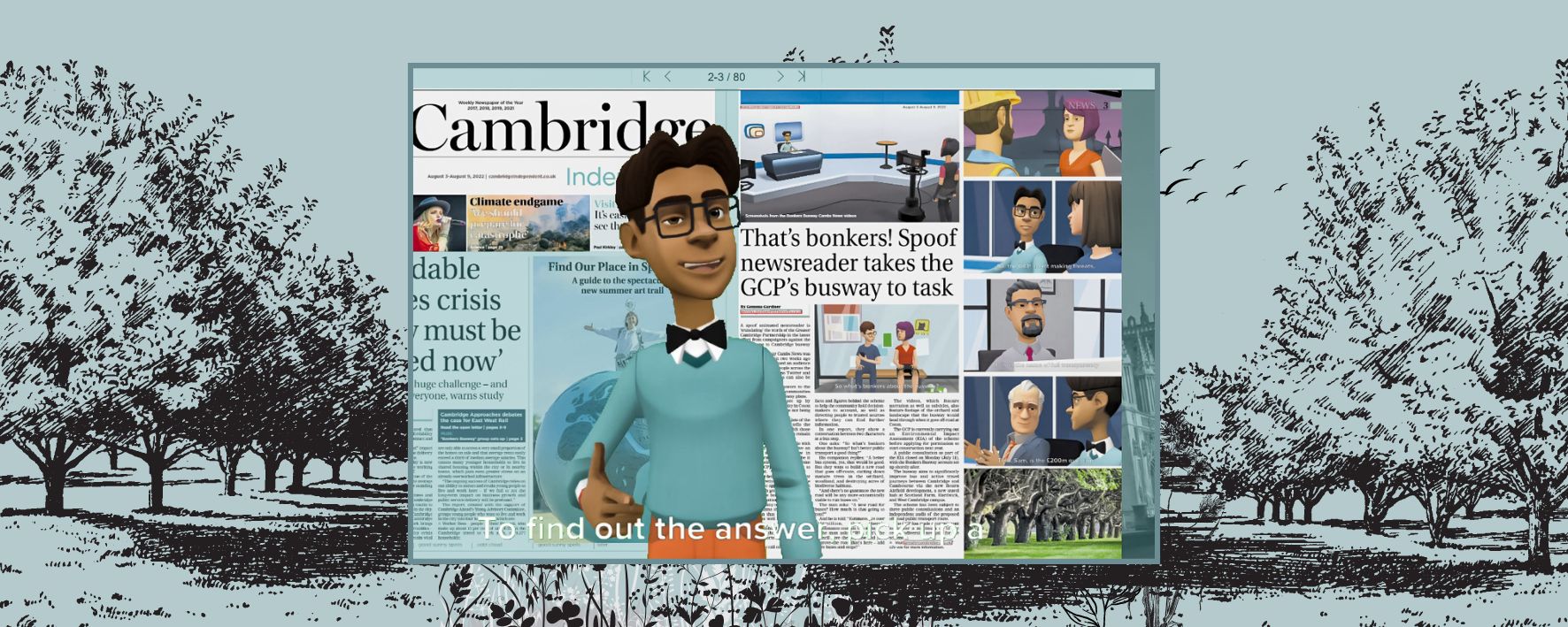


I first came across Bonkers Busway when I started working on Six Inches of Soil a couple of years ago, as both have their roots in Cambridge. A spoof BBC News channel created to raise the profile of Cambs environmental campaigners, Bonkers Busway is a campaign to stop the planned route for the Cambourne – Coton – Cambridge busway, otherwise known as C2C. The route proposed by Greater Cambridge Partnership (GCP), an organisation made up of three councils: Cambridge City, South Cambridgeshire District and Cambridge County, will slice through greenbelt land close to Coton Village and straight through Anna Gazeley’s family’s 100-year old, Coton Orchard, which is a designated County Wildlife Site (CWS).
Nominated and overseen by the Wildlife Trusts, the Orchard’s CWS status means it joins a network of sites across the region that contribute to delivering both regional and national conservation priorities. The Orchard is also under covenant to the National Trust thanks to its farmer owner from several generations ago who gave the land, which consisted of most of the village of Coton, to a local preservation charity that was at the time called the Cambridge Preservation Society and is now Cambridge Past, Present and Future. The covenant states the land is on greenbelt and is protected.
In times gone by, orchards were a common site in the UK but like many of our beautiful wild spaces they’ve disappeared quickly. The People’s Trust for Endangered Species carried out work to identify individual orchards in England (35,000) and Wales (7,000), which revealed that, “90 percent of traditional orchards have been lost since the 1950s to neglect, development or conversion to intensive modern orchards, which contribute a negative impact on biodiversity.”
The sixty-acre Coton Orchard was originally planted in 1922 for the production of apples for wholesale. For decades it’s been undisturbed by pesticides or ploughing providing an incredibly rich ecosystem with nationally rare and scarce species, huge biodiversity including invertebrates, birds, bats, other wildlife, flora and fauna, and because the soil is undisturbed it’s locking in essential carbon. To provide additional information regarding carbon sequestration I’ll refer to the wonderful Vicki Hird, who in this Sustain article explains, “Atmospheric carbon (C) is absorbed as carbon dioxide by plants via photosynthesis. Some is lost as the plant respires and the rest is incorporated into organic matter and used by the plant to create new plant mass. This roughly represents the net primary production (NPP) above and below ground. Carbon losses also occur through the organisms and processes in the soil affected by the trees especially when first planted.” In the article, Vicki also highlights some interesting research from around the world regarding carbon sequestration in orchards.

Coton Orchard holds cherished memories for Cambridge locals. Peter Rayner grew up in the Orchard as a child and then went on to work there alongside his father until he started National Service in 1952. He has incredibly fond memories and in this YouTube video on the Bonkers Busway channel, which I encourage you to watch because it’s really beautiful, Peter shares his memories of the different apple and plum varieties, Amy the Shire horse, refugees who camped there, “we were always a home for refugees”. Talking about the Council’s proposals he says, “to see the Orchard as a collection of trees is itself a flawed approach. It is and always has been one of the heritage aspects of Cambridge and the surrounding villages.”
I asked Anna when and how this nightmare for her and the family began. She explains, “My dad was sent a letter in 2015 that said there was going to be a consultation because the council wanted to put a bus route between Camborne and Cambridge. There were several options being proposed, one of which was through Madingley Hill and the Orchard, and we thought they definitely won’t do that so let’s not worry about it too much. Some locals then got together and set up the Coton Busway Action Group (CBAG) to raise awareness.” CBAG is a grass roots campaign group formed to fight the off-road busway by Coton villagers helped by members of nearby parishes. Anna adds, “We all read and completed the (extremely long) consultation, and proposed they put the busway on the road that already exists.”
To explain the backstory of C2C Anna says, “Central government gave a grant of half a billion pounds to improve infrastructure in Cambridgeshire and they formed a group called the Greater Cambridge Partnership (GCP). This is made up of Cambridge University and businesses, who don’t have a vote but who are allowed to say what they want in committee. The people who have a vote are a representative from each council including, South Cambridgeshire District Council, Cambridge City Council and Cambridge County Council. GCP receives the money in tranches, in 2015 they received the first tranche of £100 million, they received the next tranche of £200 million in 2020 and the final tranche of £200 million is subject to review in 2025. They’ve already spent £175 million and delivered nothing.”
Anna’s parents moved back to Hong Kong and in 2020 her dad’s sister-in-law and her aunt tragically both died of Covid. While Anna was trying to organise a funeral via Zoom, letters began arriving from the GCP with requests to carry out a survey. Anna says, “At the time, I didn’t know 2020 was when the next review was due. We were all locked in our houses, we weren’t supposed to see people and they were expecting me to let them carry out surveys. They wanted to do bird and bat surveys, which have to happen two hours before sunrise and two hours after sunset. Because the Orchard is within the garden centre compound I’d have had to let them in, in the middle of the night, it was a complex situation. I then received a letter that basically said, if you don’t give us access, which is our legal right, we will take you to court and request costs. At the time, I didn’t know that legally they have to ask permission for ‘reasonable access’ and that 3am is not considered ‘reasonable’. So, we accommodated it, we cut a path and put a gate into the fence and said they could use that. I got angrier and angrier but they said nobody else had complained and that no other stakeholder had a problem, it was just me.”

At this point in the conversation with Anna I was reminded of Mr Bates vs The Post Office and all those poor postmasters who were told the exact same thing: no one else has a problem it’s just you.
She then contacted the CBAG group for help. Anna says, “When I started campaigning it was more out of indignation and as I began to bring in experts I realised that everybody should worry about this bit of land and not because we’re so very special but we are what’s left, one of the few fragments of land where nature is still clinging on. We’ve had Labour councillors standing up saying apple trees are not English and that greenbelt is not that green! The two big councils in Cambridgeshire are now controlled by the Lib Dems but before that when the council was Tory run, prior to my involvement, the Lib Dems campaigned with CBAG against the proposal and even went on marches. They said concreting the greenbelt should be the last action. Then once they got voted in they did a total 180.”
I asked Anna how the Council can break the environmental protections in place, she explains, “It’s like HS2, they call it a Nationally Significant Infrastructure Project, which means the national good outweighs protections. What’s truly bonkers is the alternative route uses the existing Madingley Road. Anna says, “The council have said they won’t propose this route because they have to protect Madingley Wood, but the Wood is nowhere near the road!” Instead, the Council wants to concrete over a 100-year-old Orchard with significant environmental importance.”

Anna was very clear about her understanding for the need of the people in Cambourne to have decent public transport. She says, “You’ve got thousands of people who’ve paid good money to have homes in Cambourne. They’ve been there 20 years now and they don’t even have a Post Office. They’re being told that our campaign is getting in the way of improved public transport, improved air quality and reduced carbon, why would anybody have a problem with that? They’re going to cut down hundreds of trees to improve air quality, they’re going to add 49,000 tonnes of carbon equivalent by building a motorway bridge in between two existing bridges. A busway is still a concrete road and that adds infrastructure carbon, they’re going to dig up hundreds of thousands of tonnes of healthy soil.” Watch this YouTube video for a full explainer of the alternative route.
“Another significant point is that the GCP and the Council don’t run bus services they are run by commercial entities like Stagecoach,” says Anna. “The new busway will bypass the A14, a road that provides travel north to the science parks. The new motorway bridge will go across the M11 into West Cambridge, bypassing the slip road that would allow the bus to use the M11 to circle round Cambridge to Addenbrookes Hospital and the Biomedical Campus. This means two of the main destinations for the people from Camborne will be bypassed. If you’re a commercial bus operator, why would you run a bus service that will take your passengers to less destinations?” In this video Andy Campbell, ex-Stagecoach boss says, “there’s a fundamental flaw in the proposed busway. It’s fine while you’re on the busway section but what happens when you get closer to the city centre? There isn’t a convenient route that allows you to get into the city quickly. So, they need to solve that problem because there’s no point in building a busway and then just moving your congestion further into the city centre. And I think the other thing that they need to ensure is that there’s a minimum level of service.”
Anna adds, “It’s interesting you mentioned the Post Office (scandal) because when I saw that film it reflected so many things. Clearly I’m not in the same bracket because some of them went to prison. But it’s the “only you” line, the “you don’t understand this” narrative.
In March 2023, the route was approved and Cambridgeshire County Council gave the GCP their blessing to put in an application to the Government to start building the busway. Anna says, “They said they were going to do that last summer, then this spring and then this summer. *At the moment it’s been put on hold because the Environment Agency has raised issues around water scarcity in Greater Cambridge. Until they put the application in we can’t object and until we object there can’t be a public enquiry.”
In April 2024, the community challenged local parliamentary candidates, Conservative Chris Carter-Chapman and Green Party Oliver Fisher both spoke out against the Coton Orchard proposal. Lib Dem Pippa Heylings is calling for a public enquiry and Luke Viner, Chair of South Cambridgeshire Labour Party insisted “that will happen”.
Anna says, “A public inquiry is going to cost thousands of pounds that we don’t have, it will cost the taxpayer, and it will take more time. Every point they come up with, we’re trying to counter.” Anna is doing this through the support of some environmental heavy hitters including Chris Packham and Sir David Attenborough who said, “The greenbelt is extremely important the open green spaces of Cambridge need protection. Cambridge Past, Present and Future is doing its best to look after those things, do help it, do join it.” Chris Packham said, “We all want better public transport but I have to say you can put a bus route anywhere you like within reason but you can’t mitigate for cutting down hundreds of trees like this,” In a Tweet Springwatch presenter Iolo Williams said, “Please see sense @CambsCC. This is wanton destruction of prime wildlife habitats.”
The process for locals to dispute the proposals is arduous. Anna says, “As a member of the public in a public meeting you have to submit your question to be pre-approved. You’re allowed two minutes, maybe a minute afterwards to rebut but the rebuttal has to be based on what’s already been said. However, the councillors can stand up and talk for ten minutes and say anything they like and we’re not allowed to reply. One councillor said, ‘The campaigners say there are eight species of bats but I’ve not seen it written anywhere’. It was literally written in the report that he was holding in his hand but I can’t say anything. I think when you’re making this kind of decision, it should be a debate rather than a public meeting. The councillor also said there’s no biodiversity at Coton Orchard it’s intensively managed, they use pesticides. Yes we did in the 1990s, that’s 30 years ago. We have statements from Pesticide Free and Pesticide Action UK stating that we’re pesticide free. He then went to invoke AA Milne’s fictional character of Winnie the Pooh. AA Milne’s estate replied saying, hang on Winnie the Pooh’s best mate Eeyore likes apple pie he will not want to see a road going through an Orchard.”
Anna adds, “They also said, you can’t really call Coton Orchard veteran because the way the trees have been pruned has limited the growth of the trunk, therefore, it’s not really a veteran tree. The Tree Register responded to this saying, it’s one of the biggest Bramley trees we’ve ever recorded in the British Isles. The Woodland Trust have said, those ‘young trees’ are on our ancient tree register, they are clearly ancient, let alone veteran trees. But I couldn’t challenge these remarks in the room. They were challenged in the press and on social media after the fact but they’re still allowed to say these things in the meeting unchallenged.”
Anna says, “Even with the clear bias in their ecology report they still identified 256 species of invertebrates, 60 plus breeding species of birds, eight species of bats on the back hedge that they will cut through to make the construction compound for the bridge. They say these bats and birds are only commuting that they don’t live there but where are they going to go? And if you run a bus at fifty miles an hour down the middle of the Orchard you’re going to have lights and that will cause disruption beyond the footprint of the busway. “
The plan for this busway truly is bonkers, it’s totally destructive and absent of any environmental compassion. I’m giving the final word to Peter Rayner who in the Bonkers Busway video concludes, “I visit Cambridge rarely but I am an Old Persean (former pupil of The Perse School in Cambridge) and get information about the affairs of the area and as a consequence of being a reader of both The Times and The Observer, I have seen reference to the act of environmental vandalism. If a concrete busway is driven through the middle of the Orchard it will not just destroy 500 trees and wild habitats, it will make that Orchard impossible to manage and kill one of Cambridge’s heritages.”
*Click here to read the joint statement on addressing water scarcity in Greater Cambridge on the Gov.uk website.
More Information:
Sign the Petition which now has over 21,000 signatures.
Donate through Cambridge Past, Present & Future.
Bonkers Busway YouTube Channel
Bonkers Busway Twitter
Bonkers Busway Instagram
Leave a Reply