
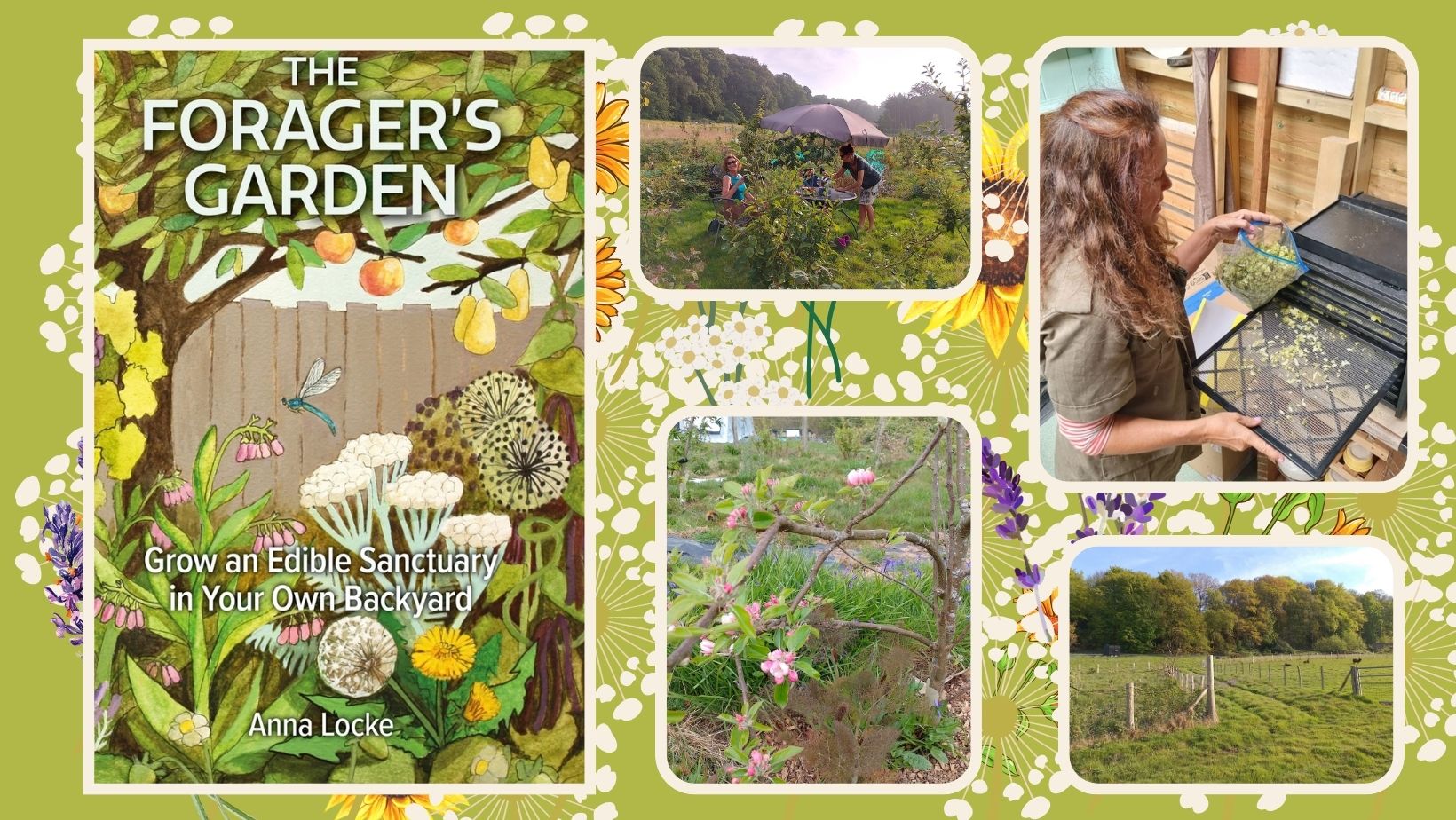


A couple of years ago, I stumbled across a beautiful book, The Forager’s Garden by Anna Locke. This book quickly became one of my go to guides. I love how Anna explains the connection between nature and growing food, the benefits this brings and how it can be achieved on a small scale. I also appreciate the step-by-step structure of the chapters, which makes the task of growing an edible garden seem less daunting. Also, the plant guide at the back of the book, where she lists a variety of edible plants for different situations, is an absolute treasure trove for those of us living in the UK who want to learn more about our native species. Examples include plants to use in layers, guilds, ground cover, nitrogen fixing, umbellifers, seasonal, what you can eat from your hedge, pollinator attractors, insect repellents, foraging categories and more. This section in my copy of the book is covered in green highlighter and many of the plants listed make up the permaculture design on my allotment plot.
I recently chatted with Anna about Small Meadow Farm her smallholding in Sussex, how she manages the land, The Forager’s Garden and more…
Can you tell me your story of coming to the land?
I’d been looking for land for over 15 years and downsizing from London to Sussex seven years ago created a way for me to make that happen. Having had a lot of allotments, I know how important it is to consider location, how you manage depending on how far away things are, can make a huge difference. I bought a field quite close to Hastings, which was a mess. I used to turn up in my Honda and have cups of tea in a thermos and just sit in the trees. It was quite hostile with brambles and thistles and trees in places that you don’t really want them. I feel like I’ve been doing extreme weeding for about seven years!
Caretaking land is about momentum. If your attention wanders elsewhere, the plant that you’ve just spent a lot of time and energy removing comes back with a vengeance and you’re back to square one. This is where permaculture design really helps because it breaks the work down into priorities so that you know what your plan is for certain areas. That’s why a forager’s garden is such a good solution because you don’t have time to maintain land if you’re juggling jobs and life. I don’t think I could do this kind of project without permaculture design. Also, you have to accept that you can’t do everything on your own. You have to ask for help with certain tasks because a smallholding is not for one person it’s for a team.
In the book you say, take at least a year to observe your patch and sometimes even longer. Can you explain the main observational considerations and share what you learnt from observing your land?
Rain, shade, light, slopes and water are key. When I got the land, I did wait a year but it’s difficult because you feel like you’re sitting on your hands. There’s a couple of things that I didn’t wait for and I should have. I had loads of maps showing where I’d put the forest garden, a growing area, or the orchard and in all those knee jerk maps they’re in the wrong place because I didn’t know intimately where the light was going to be. Fast forward to now, there’s moments in winter where the orchard fencing is exactly where light and shade is. The orchard is in the sun and the field is in the shade, which you can see in pictures on my Instagram. Those moments are really encouraging because it shows that it works to wait and observe. The orchard is north facing, so I had to be sure that the blossoms weren’t in frost areas, it needed to be in the sun as much as possible. This year, after seven years, I’ve just had an abundance of fruit. You have all this theory and then you realise the theory really works.
Observation is also about connection. Sometimes when I’m on the land I’m just being because it really helps to be present when you’re working with nature. When you’re deep in observation you go into flow and when you’re in flow, nothing else exists, it’s just the present moment. I’ve got a little woodland area and it took me a long time to recognize and identify each tree. Even after a year there was this particular tree that I couldn’t name. It turned out to be a Wych Elm, which is really rare.
That was in the days before identification apps, which I love. Do you use them?
Yes, they’re great! They show how technology can accelerate our cause. Even though we’re saying let’s reconnect to nature, it’s brilliant that you have technology to help you get there. I sat in my field for six years thinking how am I supposed to learn the birds? Now we have the Merlin app, which records their song and identifies their species. It’s fantastic!
There’s a really beautiful phrase in the book, “the soil is the soul of your garden.” Can you explain the importance of healthy soil?
There’s so much information about soil out there now, it’s really coming to the forefront. I previously worked in alternative health, I studied for a Herbal Medicine Degree, which was the reason I became so interested in plants. It was very clear back then that our food didn’t have the nutrients that we needed and a lot of people were ill because of that. If the soil is depleted, so are we. That’s still very much with me, if I’m going to take the time to grow food, I want it to be full of nutrients, or else what’s the point? I may as well just buy it from the supermarket. When you have good soil the flavour is deep. If you mulch every year at the right time, even if that’s the only thing you do, you’ll build soil.
A few years ago, there was a satellite art installation to highlight soil in London. At the time, I was really involved in the peak oil transition and then the idea of peak soil came about. Peak oil means that we now don’t have enough oil to support our needs but actually because soil is so depleted, particularly in urban areas, the soil has peaked even more. We can’t make oil but we can make soil.

You’ve got some beautiful horned sheep in your system how do they help manage the land?
Having animals changes your experience of land. They do brilliant work but I’m a gardener so I’ve had to learn how to look after them. At certain moments I have thought do I keep the sheep? Am I a good enough shepherd? Am I doing the right thing? And then it always comes back to the land management and they are faultless.
As I mentioned earlier, a lot of the field was weeds there were loads of brambles, thistles and Sycamore seedlings. I took the brambles off using a big grab tractor, they were four meters tall and spread over a third of the field. It was a huge amount of land and being a gardener, I know how hard it is to dig up bramble roots. When we had all the brambles removed, the sheep nibbled every single shoot that came up, they love brambles. They’ve literally saved me. Their poo is also a really good soil fertiliser.
The reason I called the land Small Meadow Farm is because at the very top of the field I’ve got rare Heath Spotted Orchids. They look very similar to Common Spotted Orchids, in fact I thought they were, and then an ecologist came and identified them. It was the ecologist that recommended this particular breed of sheep. They graze that top area where the orchids are from November to January. The rest of the year I keep moving them on, a bit like mob grazing. I went to an event where wild meadows expert, Keith Datchler was speaking, he’s really inspirational. He talks about how to imitate traditional land management.
You’re now connecting local people with Small Meadow Farm through food “Gatherings”. How does that work?
It’s working out how to interact the land with the community. I think the best way to connect people is through food because it’s not challenging for people, it’s not hard work, it’s fun, it’s interesting. But also, I think it really motivates people. I’m trialling things, I hosted a supper club and the theme was quince and lilac and I cooked foods in different ways using those flavours. I think the best thing to do is to try and inspire people to have a go.
Do you think permaculture is sometimes seen as over complicated?
That’s why I wrote the book because I wanted to explain that a forest garden’s not rocket science. It’s just planting a garden that you can eat. Less is more. So, with the book, I tried to pluck all the really important things out and present it in a way that says this is enough, it doesn’t have to be complicated. You can get deep with it, and you can get really scientific but in essence, what do you like to eat? Will it grow in your garden? Plant it in a place that’s easy to pick. Permaculture’s the future and we should make it simple.
Anna’s currently working on a new book. To keep up with everything that’s happening on Small Meadow Farm you can follow her on Instagram and Facebook.


Leave a Reply to abundanttimesCancel reply